
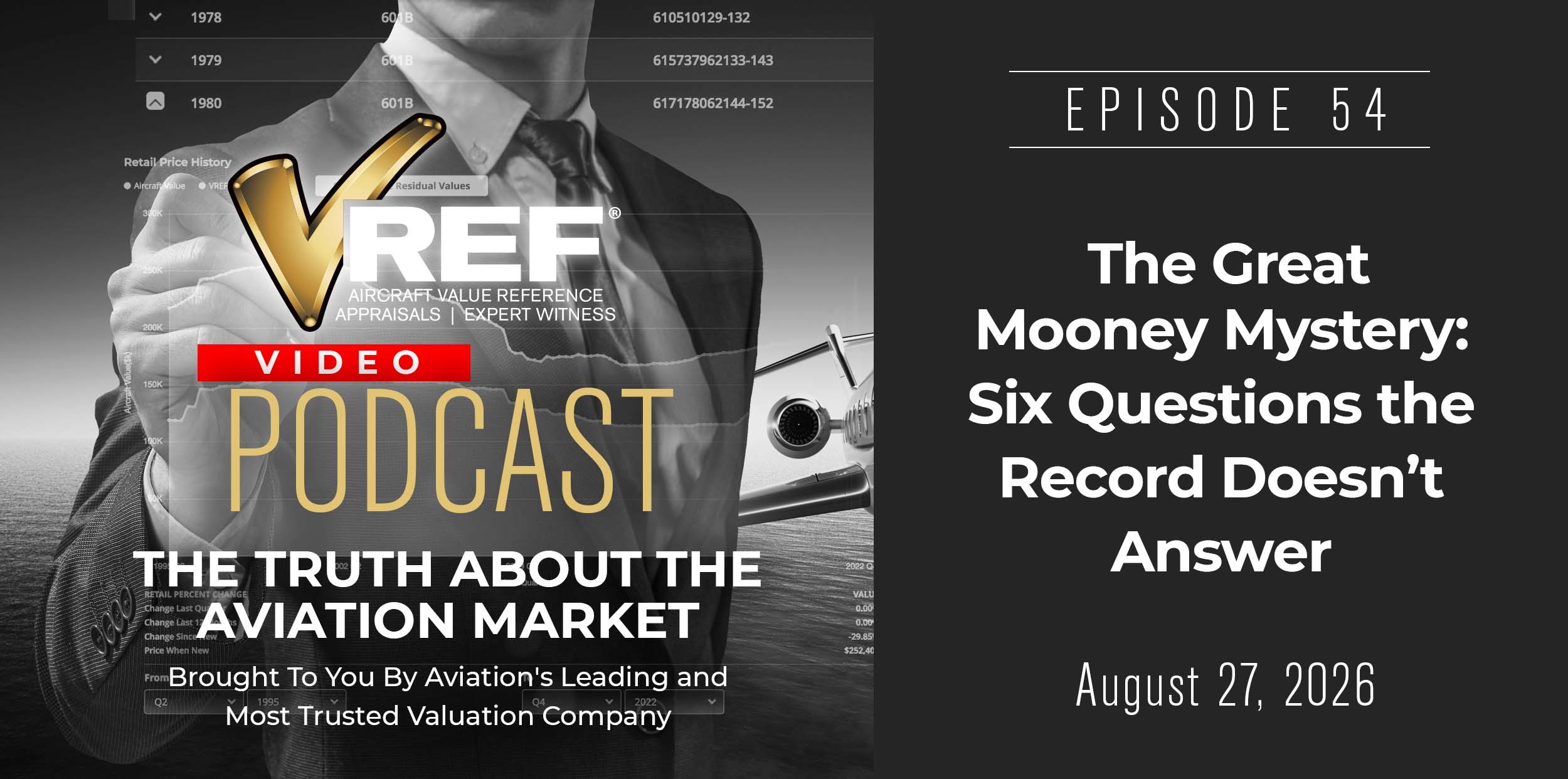
Podcast: The Truth About the Market
Host: Jason Zilberbrand, President of VREF
One of the most recognizable names in general aviation appears to have changed in a way almost nobody announced.
Jason Zilberbrand discovered it by clicking a tab on an ordinary corporate website.
At the top of the page:
Luscombe Mooney Aircraft Company.
One masthead. Two historic aircraft brands.
One of those brands supports a fleet of roughly 11,000 Mooney aircraft.
The other belonged to a manufacturer whose factory, type certificate, tooling, STCs, and inventory were offered for sale as a single lot at auction in December 2024.
There was no major announcement explaining how the two became connected.
No letter to Mooney owners.
No obvious trade-press story laying out the transaction.
So Jason went looking for the record.
Episode 54 of The Truth About the Aviation Market reconstructs what can actually be established from public information — and, just as importantly, identifies what cannot yet be confirmed.
This is not an allegation.
It is an investigation into what happens to aircraft value when critical information about the companies supporting a fleet becomes difficult to see.
In this episode:
- Why a dormant aircraft manufacturer can still represent an extraordinarily valuable business
- Why the factory isn’t necessarily the asset — the installed fleet is
- How roughly 11,000 existing Mooneys create recurring captive demand for certified parts
- What was publicly announced in January 2026 about rebuilding Mooney’s parts operation
- Why the word “stewardship” matters when discussing ownership and control
- How, seven months later, Luscombe and Mooney appeared together under one company masthead
- Why Mooney’s domain, factory address, and phone number make that development especially noteworthy
- What happened to the Luscombe Aircraft Corporation assets at a December 2024 auction
- Why the combination of two type certificates, tooling libraries, legacy brands, and installed fleets may make sense as an industrial strategy
- Why restarting new-aircraft production may be far less important than parts, MRO, subcontract manufacturing, and certification assets
- How type certificates themselves can function as valuable assets
- The most important valuation question facing Mooney owners now
- And the six major questions the public record still has not answered
The real business may not be building airplanes
Jason argues that the economics of a dormant OEM are easy to misunderstand.
Thousands of airplanes remain in service regardless of whether new ones are rolling off the line.
Those aircraft still require parts.
Maintenance.
Repairs.
Tooling.
Technical support.
And legally approved components.
That makes an installed fleet a recurring economic asset.
The website now describes operations spanning aircraft, manufacturing, MRO, propellers, tooling, and spares.
If that structure develops as presented, Jason sees a potential four-part business model:
Aftermarket parts.
MRO.
Industrial subcontracting.
Type certificates and certification assets.
New aircraft may provide the romance.
The installed fleet may provide the business.
What does this mean for Mooney values?
This is where the story becomes directly relevant to aircraft owners.
Jason’s central valuation point is simple:
Parts availability is one of the biggest drivers of value in an out-of-production fleet.
If the new structure produces reliable inventory, reasonable lead times, responsive support, and a healthy parts pipeline, that could be supportive of Mooney residual values.
Even higher parts prices may be preferable to owning an aircraft that simply cannot be repaired.
But the opposite case matters too.
If prices rise while availability fails to improve, marginal aircraft can become uneconomical to repair.
Those airplanes become donors.
Donor aircraft temporarily improve parts availability — while simultaneously shrinking the operating fleet and pushing more aircraft toward salvage economics.
Jason has seen that cycle before.
And it can become self-reinforcing.
Four numbers VREF will be watching:
Parts lead times
Mooney days on market
The asking-to-closing spread
Transaction volume versus prior periods
The data should begin revealing which direction the fleet is moving before any press release does.
Six unanswered questions
Jason closes the investigation by putting the gaps directly on the table:
- Who acquired the Luscombe assets at the December 2024 auction, and at what price?
- When was the Texas LLC formed, and who manages it?
- Who currently holds the relevant Mooney type certificates and production certificates?
- What became of the entities from Mooney’s previous corporate structure?
- Where did the capital supporting the parts program and broader operation come from?
- Which operations described on the website are functioning today versus planned or claimed capabilities?
Every one of those questions could have an ordinary, legitimate answer.
Private companies are not required to issue press releases every time assets move.
Business structures evolve.
Stewardship arrangements can change.
And silence is not evidence of wrongdoing.
But for aircraft owners, opacity itself has economic consequences.
When the future of a parts pipeline, type certificate, or factory can materially change the value of a six-figure asset, information matters.
Jason’s conclusion:
Sunlight isn’t a courtesy in an asset market. It’s infrastructure.
For Mooney owners — and anyone who owns an out-of-production aircraft — this episode is about much more than one mysterious website.
It is about the invisible assumptions underneath your aircraft’s value.
Track the market before the market surprises you.
The next VREF aircraft value update goes live September 1.
For accurate, defensible aircraft valuations trusted by lenders, insurers, attorneys, operators, and aviation professionals worldwide, get started with your VREF Online Membership today.
Subscribe to VREF Online to access the latest values as soon as they’re released, or order your quarterly Valuation Guidebook now.
VREF it before you make the call.
The market doesn’t care what the website says…
It only cares what the record shows.
Fly safe. Stay smart.