
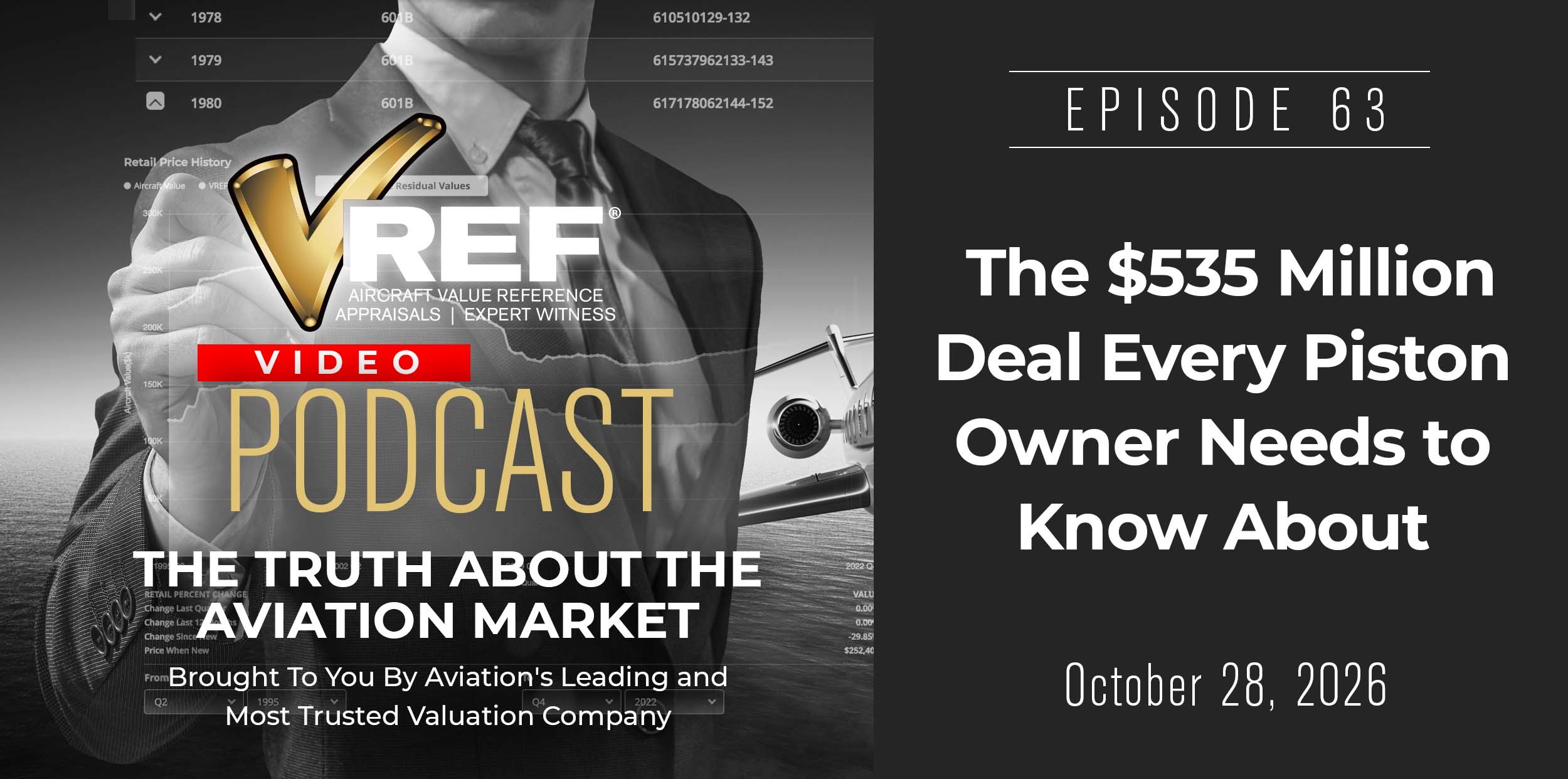
Podcast: The Truth About the Market
Host: Jason Zilberbrand, President of VREF
Continental’s $535 Million Sale, the Hidden Cost of Engine Time, and the Truth About Selling Without a Broker
A Bonanza owner wakes up tomorrow, walks into the hangar, and finds the same airplane that was there yesterday.
Same engine.
Same hours.
Same maintenance history.
Not a single thing has changed.
But suppose the price of a factory engine overhaul increases by 10%.
What happens to the airplane’s value?
That question just became considerably more relevant for tens of thousands of general aviation aircraft.
Continental Aerospace Technologies, one of the world’s most important piston aircraft engine manufacturers, has changed hands in a transaction valued at approximately $535 million.
After roughly 15 years under ownership associated with China’s Aviation Industry Corporation of China (AVIC), the Mobile, Alabama-based manufacturer has been acquired by U.S. private equity firm Arcline Investment Management.
The transaction closed on September 30, 2026.
And there is an important detail that makes this acquisition particularly interesting.
Arcline already owns Hartzell Propeller.
That places two major suppliers of general aviation propulsion systems under common investment ownership.
For owners of Bonanzas, Cessna 210s and 206s, Cirruses, Mooneys, Senecas, Barons, and other Continental-powered aircraft, the implications extend well beyond corporate ownership.
An aircraft engine is not simply a mechanical component.
It is one of the largest variables in the aircraft’s market value.
Its condition, hours, overhaul requirements, and replacement costs directly influence what buyers are willing to pay.
And those costs are shaped by decisions made far outside the hangar.
But that’s only half the story.
Because Episode 63 of The Truth About the Aviation Market also addresses one of the most common questions from piston-aircraft owners:
Do you really need a broker to sell your airplane?
The answer is not always yes.
And it is not always no.
In fact, the more important question comes before the decision to hire a broker.
Is the airplane priced to sell—or priced to sit?
Two seemingly different subjects.
One common thread.
The economics of aircraft ownership are ultimately reflected in the number a buyer is willing to pay.
And getting that number wrong can be far more expensive than most owners realize.
In this episode
- The approximately $535 million acquisition of Continental Aerospace Technologies and what it means for general aviation
- Why Continental’s transition from AVIC-associated ownership to a U.S. private equity firm deserves the attention of piston aircraft owners
- What Arcline’s existing ownership of Hartzell Propeller could mean for the engine-and-propeller supply chain
- Why private equity ownership could bring meaningful benefits—or greater financial pressure—to the installed aircraft fleet
- The five critical indicators that will reveal how Continental’s new ownership affects aircraft owners
- Why factory overhaul and exchange pricing can influence the resale value of thousands of airplanes
- How an aircraft can become less valuable without flying another hour
- Why buyers and sellers must account for current engine overhaul costs rather than relying on outdated estimates
- How rising maintenance costs could influence the broader piston market, including Lycoming-powered aircraft
- Whether the typical piston owner actually needs an aircraft broker
- The real economics of a 5% brokerage commission on a $180,000 airplane
- Why avoiding a broker’s fee can sometimes cost more than paying it
- When a broker’s expertise, buyer relationships, and transaction management justify the commission
- When a knowledgeable owner may be better off selling privately
- Why complicated maintenance histories, missing logbooks, damage history, and engine issues can make professional representation valuable
- How to choose a broker who understands market value rather than simply agreeing with the seller’s asking price
- Why asking-price-based valuation tools can create misleading expectations
- How engine time can become the biggest disagreement between buyer and seller
- Why an overpriced airplane can sit for months, accumulate ownership expenses, and ultimately sell for less
- The practical checklist every piston owner should follow before buying or selling
- And why the best way to sell an airplane starts with understanding what it is actually worth
Continental Aerospace Technologies: a major change in general aviation
Continental has been part of American aviation for more than a century.
Founded in 1905 and headquartered in Mobile, Alabama, the company manufactures piston aircraft engines and supplies the extensive aftermarket supporting those engines.
Its products and services include:
Certified aviation gasoline engines, Jet-A piston engines, cylinders, replacement components, factory overhauls, and exchange engines.
Its installed base extends across many of the most recognizable piston aircraft types.
In June 2026, Arcline Investment Management announced an agreement to acquire Continental’s holding company for approximately $535 million.
The seller’s ownership structure was tied to AVIC, the Chinese state-owned aerospace conglomerate.
The transaction involved the sale of the engine business, with the Hong Kong-listed holding company pursuing a shareholder distribution, delisting, and winding-up process.
This was not simply a merger between two operating engine companies.
It represented a fundamental change in the ownership of a major manufacturer supporting the general aviation fleet.
The transaction closed on September 30, 2026.
But the most important question for aircraft owners is not who received the sale proceeds.
It is what the new ownership means for future costs, product support, and aircraft value.
Why Arcline’s ownership of Hartzell matters
Arcline is not entering the general aviation market for the first time.
Its portfolio already includes Hartzell Propeller, operating within the Signia Aerospace group.
That means Continental’s acquisition brings a major piston engine manufacturer into an investment portfolio that already includes one of the industry’s leading propeller manufacturers.
Both businesses supply equipment that aircraft owners depend on to keep their airplanes operational.
Both have extensive aftermarket relationships.
And both support products that can remain in service for decades.
This creates opportunities.
Shared resources could improve manufacturing efficiency.
Coordinated investment could strengthen engineering and aftermarket support.
More integrated engine and propeller offerings could reduce costs for some customers.
But common ownership also introduces important questions about pricing power.
When major components and services are concentrated within the same corporate portfolio, owners become more exposed to decisions made by that portfolio.
That does not establish that prices will increase.
It does establish why the ownership change deserves scrutiny.
The potential benefits are real. So are the questions.
What private equity ownership could mean for Continental
Private equity ownership is neither inherently good nor inherently bad for an aircraft manufacturer.
The outcome depends on the investment strategy and how it is implemented.
An investor with experience in aerospace manufacturing may bring financial resources, operational expertise, and the ability to modernize production.
That could benefit aircraft owners.
But private equity investments also create incentives to improve the profitability and value of acquired businesses.
For a manufacturer serving a mature installed fleet, increasing earnings does not necessarily depend on selling dramatically more new aircraft engines.
Aftermarket revenue is an important part of the business.
Aircraft owners continue to need:
Overhauls.
Exchange engines.
Cylinders.
Replacement parts.
Technical support.
Warranty service.
These needs exist regardless of whether the market for newly manufactured airplanes is expanding.
That makes Continental’s aftermarket business especially important.
A manufacturer serving an established installed fleet can potentially improve financial performance through pricing, efficiency, production capacity, product development, or some combination of those factors.
There is no basis for concluding that Continental’s new ownership will necessarily pursue higher prices at the expense of customers.
But there is equally little reason to assume that ownership changes will have no effect.
The evidence will come from what happens next—not from the acquisition announcement.
Five things Continental-powered aircraft owners should watch
The next 12 to 18 months will be particularly important for evaluating how the ownership change affects the market.
Five areas deserve close attention.
1. Factory overhaul and exchange pricing
This is potentially the most important variable for aircraft values.
Factory overhaul and exchange costs influence the price differences buyers assign to airplanes with fresh, midtime, and high-time engines.
Meaningful changes in those costs could alter valuation adjustments across affected aircraft models.
2. Parts pricing and availability
Aircraft owners depend on access to replacement parts.
The cost of cylinders, ignition components, and other essential equipment directly influences operating expenses.
Availability matters just as much as price.
A relatively inexpensive component that cannot be obtained can keep an aircraft grounded.
3. Technical support and warranty service
Support quality affects ownership confidence.
Response times, warranty administration, service bulletins, and factory technical assistance all influence the experience of maintaining an aircraft.
Strong support can reinforce demand for the installed fleet.
Deteriorating support can create uncertainty and discourage buyers.
4. Investment in new products
Continental has invested in Jet-A piston engine technology and other product development.
Future decisions will reveal how the company balances ongoing research and engineering with the financial priorities of its new ownership.
Some investments may produce returns over many years.
Whether those projects continue, expand, or change direction will be an important indicator of the company’s long-term strategy.
5. Integration with Hartzell and other portfolio businesses
Common ownership of major propulsion-related suppliers creates opportunities for operational efficiencies and coordinated offerings.
It also makes corporate pricing and support strategies worth monitoring.
Engine and propeller packages could become more attractive.
Or some owners could experience reduced flexibility in obtaining particular products or services.
The outcome is not yet established.
VREF will be watching all five indicators—with particular attention to how actual cost changes affect aircraft values.
Why engine time is one of the biggest adjustments in piston aircraft valuation
A piston airplane’s engine can represent a substantial portion of its economic value.
Two otherwise similar aircraft may have very different market values simply because of their engine histories.
Consider two Bonanzas of the same model year.
Both have comparable equipment.
Both have similar paint and interiors.
Both have complete maintenance records.
But one has a freshly overhauled engine.
The other is halfway through its expected overhaul interval.
The second airplane carries a future maintenance obligation that the first does not carry to the same degree.
A knowledgeable buyer accounts for that difference.
Engine valuation is not necessarily a simple dollar-for-dollar calculation based on remaining hours. Condition, overhaul history, operating history, maintenance circumstances, and market demand also matter.
But the cost of the next overhaul provides an essential economic reference point.
That is why factory pricing matters so much.
A change in the cost of maintaining an engine can change what buyers are willing to pay for the aircraft carrying it.
The $100,000 engine question
Consider a Continental IO-550-powered Bonanza.
The episode uses an illustrative installed factory overhaul or remanufactured-engine cost exceeding $100,000.
Now compare two otherwise similar airplanes.
One has a fresh engine.
The other is at midtime.
The midtime aircraft has already consumed a meaningful portion of the engine’s expected service interval.
That difference is reflected in the buyer’s valuation.
Now suppose the cost of the relevant engine work rises by 10%.
The cost of the future maintenance event increases.
The buyer’s financial exposure increases.
And the price adjustment associated with engine time may increase as well.
The airplane has not changed. The cost of its future maintenance has.
The exact effect on resale value will depend on market conditions and the aircraft’s characteristics. A 10% increase in overhaul cost does not automatically mean a 10% decrease in aircraft value.
But the relationship is economically important.
This is the connection between factory pricing and residual value.
It is also why aircraft owners should be cautious about relying on overhaul estimates from several years ago.
A buyer making a purchase today needs to consider the costs that exist today—and the reasonable risks associated with future costs.
What this means for owners of Lycoming-powered aircraft
Continental owners are the most directly exposed to decisions involving Continental’s products.
But the broader piston market does not operate in isolation.
Continental and Lycoming are two major manufacturers serving overlapping portions of general aviation.
Changes in one company’s pricing, capacity, and aftermarket offerings can influence the competitive environment in which the other operates.
That does not mean a change at Continental automatically produces the same change at Lycoming.
It means owners of both engine families benefit from understanding the current economics of engine maintenance and replacement.
Overhaul cost is a market variable—not a number permanently fixed when an aircraft was purchased.
The second question: do you really need an aircraft broker?
The second half of Episode 63 addresses a completely different decision with surprisingly similar economics.
For a piston-aircraft owner preparing to sell, the brokerage commission is often the first concern.
On a relatively modest transaction, paying a broker can feel unnecessary.
Why pay a professional thousands of dollars to sell an airplane that already has an established buyer market?
It’s a reasonable question.
But deciding whether to hire a broker requires looking beyond the commission.
The more useful comparison is:
What will each approach actually cost by the time the airplane sells?
That includes the sale price, brokerage fee, carrying costs, marketing time, transaction complexity, and the owner’s own time.
The $9,000 commission versus the cost nobody calculates
Consider a $180,000 airplane.
A hypothetical 5% brokerage commission would cost $9,000.
That is the visible expense.
It’s easy to calculate.
It’s written into an agreement.
And it feels substantial.
Now consider an owner who chooses to sell privately and lists the same airplane at $199,000 based on optimistic asking-price comparisons.
The aircraft sits.
The owner continues paying hangar expenses.
Insurance remains due.
Loan payments may continue.
The annual inspection gets closer.
The engine continues aging on the calendar.
Eventually, the asking price comes down.
Then it comes down again.
Six months later, the airplane may finally sell around the market value it could have supported when first listed.
Except now the owner has incurred additional carrying costs and spent months managing inquiries.
The listing has also developed a history.
Buyers can see how long it has been advertised.
That can encourage lower offers and create concerns about why the aircraft has not sold.
The apparent savings from avoiding a commission may disappear.
The example is illustrative rather than a universal cost estimate.
But the underlying principle is clear:
The brokerage commission is not necessarily the most expensive part of selling an airplane. Mispricing can be.
An overpriced listing can make a broker even more expensive
Hiring a broker does not solve a pricing problem automatically.
In fact, a broker who agrees to an unrealistic asking price simply to obtain the listing can make the situation worse.
The owner may end up paying both:
The brokerage commission.
And the additional carrying costs associated with a prolonged sale.
A broker who tells an owner exactly what they want to hear is not necessarily providing valuable advice.
A broker who presents defensible market evidence—even when the number is uncomfortable—may be providing substantially more value.
This is why broker selection should begin with a simple question:
What is the airplane actually worth, and how was that number determined?
The answer should involve relevant market transactions and aircraft-specific adjustments.
Not simply the highest asking price available online.
Five situations where an aircraft broker can earn the commission
Not every airplane is equally easy to sell.
Some transactions require substantial expertise, specialized buyer relationships, or difficult coordination.
Professional representation can be especially valuable in the following situations.
1. The aircraft is complicated or has a limited buyer pool
Turbocharged aircraft.
Pressurized piston aircraft.
Light twins.
Heavily modified airplanes.
Unusual equipment configurations.
Aircraft with limited market activity.
These aircraft can require specialized knowledge to identify qualified buyers and communicate their value.
A broker who understands a specific type may have relationships with buyers who would otherwise be difficult to reach.
2. The aircraft has a history that requires careful explanation
Damage history.
A propeller strike.
Missing logbook entries.
An unusual engine history.
Major modifications.
Complex maintenance circumstances.
These issues do not automatically make an airplane unsellable.
But they often require careful documentation and honest communication.
A qualified broker can help present the facts accurately and prepare buyers for legitimate questions before the pre-purchase inspection.
Trying to conceal material history can destroy a transaction when the information eventually surfaces.
Transparency protects the transaction.
3. The owner cannot manage the sales process
Selling an airplane involves more than posting a listing.
Inquiries must be answered.
Buyers must be qualified.
Showings must be arranged.
Documentation must be provided.
Pre-purchase inspections must be coordinated.
Discrepancies must be negotiated.
For owners without the time or availability to manage those responsibilities, a broker can provide genuine value.
The ability to respond quickly and professionally can affect whether a serious buyer remains interested.
4. There are multiple sellers or complicated circumstances
Estate sales.
Partnership dissolutions.
Divorces.
Ownership disputes.
Transactions involving strict deadlines.
These situations can involve multiple decision-makers, legal considerations, and strong emotions.
A neutral professional can help keep the process organized and prevent avoidable disagreements from derailing the sale.
5. The transaction involves distant or international buyers
An aircraft may need to be inspected, purchased, exported, deregistered, or repositioned across substantial distances.
International transactions can require specialized paperwork and coordination.
Experienced representation may substantially reduce the owner’s administrative burden and the risk of costly mistakes.
When selling an aircraft privately can make sense
A broker is not required for every piston-aircraft transaction.
For some owners, a private sale may be the most efficient approach.
That is particularly true when several favorable conditions exist.
The aircraft is common and easy to understand
Popular models such as Cessna 172s, Pipers, Cherokees, and Archers have established buyer markets.
A clean, conventional example may be relatively straightforward to present.
The records are complete and organized
Maintenance records should be accurate, complete, and readily available.
Scanned logbooks can help buyers evaluate an airplane before traveling to inspect it.
Good documentation builds confidence.
Incomplete or disorganized records create questions.
The seller is accessible
Private sellers must be prepared to answer inquiries, coordinate inspections, communicate promptly, and participate in negotiations.
The process requires time.
An owner unwilling or unable to provide that time may benefit from professional representation.
The airplane is priced correctly
This is the most important condition.
An owner with complete records, a desirable aircraft, adequate availability, and a defensible asking price may be able to sell privately without sacrificing net proceeds.
The money saved on a commission can be meaningful.
But that advantage depends on the price being right from the beginning.
The broker is not always the deciding variable. The asking price often is.
Why listing-site valuations can create expensive mistakes
Aircraft listing platforms make market information widely accessible.
That visibility is useful.
But advertised asking prices should not be confused with completed transactions.
An asking price represents a seller’s expectation.
A closing price represents an actual agreement between buyer and seller.
Those numbers may be very different.
The problem becomes more pronounced when valuation tools rely heavily on advertised prices.
One optimistic asking price informs another.
Sellers compare their aircraft to airplanes that have not sold.
Those listings remain online.
They continue influencing expectations.
Meanwhile, correctly priced aircraft disappear from the listings when they close.
The result can be a distorted picture of market value.
The listings that remain visible are not necessarily representative of the transactions that are actually happening.
VREF’s methodology emphasizes transaction evidence and aircraft-specific valuation adjustments, including engine time, equipment, maintenance condition, and history.
That provides a different starting point from simply averaging public asking prices.
Why 90 days matters—but is not a guarantee
A properly priced aircraft generally has a stronger opportunity to attract serious buyer interest and transact without prolonged exposure.
Episode 63 uses approximately 90 days as a practical selling objective for aircraft priced near supported market values.
That should not be interpreted as a guarantee that every airplane will sell within 90 days.
Actual transaction timelines depend on aircraft type, condition, location, market demand, documentation, financing, and other circumstances.
The larger point is about what happens when a seller starts significantly above the market.
Extended marketing time creates expenses.
Repeated price reductions can weaken negotiating leverage.
And the aircraft may eventually sell for the amount the market would have supported at the beginning—after months of unnecessary ownership costs.
Time does not make an overpriced airplane worth more simply because it remains listed.
Where Continental’s acquisition and aircraft brokerage intersect
The two stories in Episode 63 are ultimately connected.
The first explains why engine overhaul costs influence piston-aircraft values.
The second explains why accurately reflecting those costs in an asking price is essential to selling efficiently.
Imagine a midtime-engine airplane advertised as though its engine were freshly overhauled.
The seller sees a desirable aircraft with plenty of utility remaining.
The buyer sees an aircraft with a substantial future overhaul expense.
Those perspectives produce different numbers.
And if factory overhaul costs rise, the gap between the two valuations may widen.
The aircraft may be beautifully maintained.
It may have excellent avionics.
It may have fresh paint.
But the buyer still needs to account for the engine.
This is one of the most important sources of disagreement in piston-aircraft pricing.
The seller may remember what the overhaul used to cost. The buyer has to consider what it will cost.
That difference can determine whether the transaction closes.
The practical checklist for piston-aircraft owners
Whether buying, selling, financing, insuring, or simply continuing to own a piston aircraft, the episode recommends a clear sequence of actions.
Step 1: Obtain a current engine overhaul or exchange quote
Identify the actual engine model and the relevant maintenance options.
Use current pricing.
Avoid relying on outdated estimates or what the previous owner paid.
Step 2: Obtain an aircraft-specific VREF valuation
Use the correct model, serial number, equipment, maintenance information, and engine time.
Review the adjustment associated with engine condition and time since overhaul.
Step 3: If selling, decide whether professional representation is appropriate
Evaluate the aircraft’s complexity, documentation, buyer pool, and the owner’s availability.
Calculate the commission against the possible costs of marketing the airplane privately.
Step 4: Set the asking price using defensible market evidence
Review relevant closed transactions and aircraft-specific differences.
If using a broker, require an explanation of the proposed listing price.
A higher number is not automatically a better strategy.
Step 5: Prepare the aircraft and documentation before marketing
Organize and scan maintenance records.
Identify outstanding issues.
Prepare accurate equipment and specification information.
Address material questions honestly.
Step 6: Establish appropriate transaction protections
Agree on pre-purchase inspection procedures in writing.
Use qualified title and escrow services.
Verify wire instructions independently.
Do not eliminate essential protections simply to save a small amount on closing expenses.
Step 7: Continue monitoring engine costs
Factory overhaul pricing, component costs, support quality, and parts availability can all influence ownership economics.
Continental’s new ownership makes those variables particularly important to monitor.
An invitation to piston-aircraft owners
Episode 63 also invites owners considering a sale to contribute examples for a future discussion of real aircraft pricing.
The information requested is straightforward:
Aircraft year, model, engine type, home base, and proposed asking price.
No owner’s name or tail number is required for the initial submission.
Send the information to info@vref.com or share the details in the episode comments.
Selected examples can be evaluated against market evidence and discussed in a future episode to illustrate the difference between a supported asking price and an aspirational one.
The goal is education.
Not to embarrass sellers.
Not to promote a particular broker.
But to make the market more transparent and help owners understand the economics behind the number.
Frequently Asked Questions
Who owns Continental Aerospace Technologies in 2026?
Continental Aerospace Technologies was acquired by Arcline Investment Management, a U.S. private equity firm, in a transaction valued at approximately $535 million.
The acquisition closed on September 30, 2026.
Continental had previously been owned through a structure associated with AVIC, China’s state-owned aviation conglomerate.
The new ownership also has investments in other aerospace and general aviation businesses, including Hartzell Propeller.
Why did AVIC sell Continental?
The precise motivations behind AVIC’s decision were not established in the episode.
The transaction involved a sale of the operating business followed by plans for shareholder distributions and the wind-up of the former publicly listed holding company.
That structure demonstrates a significant ownership exit.
It does not, by itself, establish why the seller chose to exit.
Claims that the sale was motivated by particular political, economic, regulatory, or operational circumstances would require additional evidence.
Does Arcline Investment Management also own Hartzell Propeller?
Yes.
Hartzell Propeller is part of Arcline’s investment portfolio through Signia Aerospace.
Continental’s acquisition therefore places a major piston engine manufacturer and a major propeller manufacturer under common investment ownership.
This could create opportunities for coordinated investment, manufacturing efficiency, and aftermarket offerings.
It also makes the combined portfolio’s pricing and support strategies worth monitoring.
Will Continental engine overhaul prices increase under private equity ownership?
That has not been established.
Private equity ownership can create incentives to improve profitability, but those improvements can come from many sources, including operational efficiency, manufacturing investment, new products, and pricing.
The acquisition does not prove that overhaul prices will increase.
The appropriate approach is to monitor actual factory price lists, overhaul and exchange quotes, component costs, and service performance.
Future pricing should be evaluated from evidence, not assumptions about ownership.
Could Continental’s new ownership affect the value of a Bonanza, Cessna 210, or Cirrus?
Potentially.
Engine overhaul and replacement costs are important factors in the valuation of Continental-powered aircraft.
If those costs change materially, the market may adjust the discounts or premiums associated with different engine conditions and overhaul histories.
The actual effect will vary by aircraft model, installed engine, maintenance status, and market demand.
An ownership change alone does not establish a loss in aircraft value.
How does engine time affect aircraft resale value?
Engine time helps buyers estimate the remaining service utility and potential future expense associated with an aircraft’s engine.
A freshly overhauled engine and a high-time engine generally do not contribute identical amounts to market value.
The difference is influenced by current overhaul costs, remaining time, maintenance history, condition, and buyer expectations.
Time since overhaul is an important input, but it is not the only measure of engine value.
Can an airplane lose value without flying another hour?
Yes.
An aircraft’s market value depends on more than physical changes to the airplane.
Changes in maintenance costs, replacement parts availability, engine overhaul pricing, operating expenses, financing conditions, and buyer demand can affect the price buyers are willing to pay.
An airplane can remain physically unchanged while the economics of owning it become more or less attractive.
That distinction is central to Episode 63.
How much does a Continental IO-550 overhaul cost?
The episode uses a broad example of an installed factory overhaul or remanufactured-engine expense exceeding $100,000 for a Bonanza equipped with a Continental IO-550.
That is an illustrative reference rather than a universal current quote.
Actual costs depend on the exact engine model, overhaul versus remanufacture or exchange, labor, accessories, required additional work, and other circumstances.
Owners should obtain current quotes specific to their engines.
Does a 10% increase in overhaul cost mean my airplane loses 10% of its value?
No.
A 10% increase in overhaul cost does not automatically produce a 10% decline in the aircraft’s market value.
However, higher overhaul costs can increase the buyer’s expected future maintenance expense.
That may affect the valuation adjustment applied to airplanes with different engine times or conditions.
The relationship depends on the aircraft and the market.
The key principle is that changes in future ownership costs can influence present market value.
Do owners of Lycoming-powered aircraft need to be concerned?
Continental’s ownership change most directly affects owners using Continental products and services.
However, manufacturers compete and operate within a broader aviation market.
Pricing, availability, and support changes at a major manufacturer may influence competitive conditions across the industry.
That does not establish that Lycoming will follow any particular pricing strategy.
Owners of either engine type should maintain current information about engine overhaul and maintenance costs.
Do I need a broker to sell my piston airplane?
Not necessarily.
Many owners can successfully sell their airplanes privately, particularly when dealing with common aircraft models, complete maintenance records, straightforward histories, and established buyer demand.
However, complex aircraft, specialized configurations, limited buyer pools, difficult maintenance histories, or international transactions may benefit substantially from professional representation.
The decision should be based on the value a broker can add—not simply on the desire to avoid a commission.
How much does an aircraft broker charge?
Brokerage commissions vary by company, transaction, aircraft value, and the services provided.
Episode 63 uses an illustrative commission of 5%.
On a $180,000 aircraft, that equals $9,000.
The actual fee is negotiable and depends on the brokerage agreement.
Owners should understand what services the fee includes and consider the expected net proceeds after carrying costs and other transaction expenses.
Is it cheaper to sell an airplane without a broker?
It can be.
A private seller who correctly prices an aircraft, maintains complete records, communicates effectively with buyers, and manages the transaction can avoid brokerage expenses.
But selling privately is not automatically cheaper.
An overpriced listing can accumulate months of hangar expenses, insurance, financing costs, and other ownership obligations.
The correct comparison is the seller’s net proceeds after all costs, not the commission alone.
When is hiring an aircraft broker worth the commission?
A broker can provide particular value when the aircraft is difficult to market, the buyer pool is limited, or the transaction involves substantial coordination.
Examples include pressurized aircraft, twins, highly modified airplanes, damage-history questions, incomplete records, estates, partnerships, and international transactions.
Specialized market knowledge and buyer relationships can help a broker communicate value, qualify buyers, and manage complicated negotiations.
How do I choose the right aircraft broker?
Begin by asking:
What is the aircraft worth, and what evidence supports that number?
A qualified broker should explain the proposed asking price using relevant market data and aircraft-specific information.
Experience with the particular aircraft type is also valuable.
Owners should understand the broker’s compensation, marketing strategy, transaction process, communication expectations, and experience handling comparable sales.
Be cautious of any recommendation based primarily on the highest advertised price available.
Should I choose the broker who recommends the highest listing price?
Not automatically.
A high listing price may sound attractive, but it does not guarantee a higher closing price.
An unsupported asking price can increase marketing time, carrying costs, and the likelihood of repeated reductions.
The most valuable broker may be the one who provides a realistic number supported by transaction evidence, even when that number is lower than the seller hoped.
The goal is not the highest listing price. It is the best achievable transaction outcome.
Why do some piston airplanes sit on the market for months?
There are many possible reasons.
Condition, equipment, maintenance history, location, buyer demand, and financing can all affect marketing time.
But an asking price substantially above market-supported value is a common obstacle.
Airplanes listed at realistic prices are often better positioned to attract serious interest.
Airplanes listed significantly above current market expectations may accumulate time, carrying costs, and repeated price reductions.
Will an airplane priced at VREF always sell within 90 days?
No valuation can guarantee a particular selling timeline.
Episode 63 emphasizes approximately 90 days as a practical objective for aircraft priced appropriately to the market.
Actual selling time depends on numerous factors, including aircraft type, condition, available inventory, buyer financing, documentation, and economic conditions.
An independent valuation improves the basis for pricing decisions, but it cannot guarantee a sale.
Are free aircraft valuation tools accurate?
Their usefulness depends heavily on their methodology and underlying data.
Tools that primarily rely on advertised asking prices may reproduce seller expectations rather than actual transaction outcomes.
That can create misleading value estimates, particularly when many listings remain unsold.
Closed transactions provide stronger evidence of prices buyers and sellers actually agreed to.
VREF evaluates aircraft using market evidence and aircraft-specific adjustments rather than relying solely on asking-price averages.
Does a new engine increase aircraft value by its full installation cost?
Not necessarily.
The cost of installing an engine and the amount the market adds to an aircraft’s resale value are different concepts.
Buyers consider the engine’s condition, age, documentation, installation, overhaul status, and the alternatives available in the market.
An expensive upgrade may improve marketability and value without returning its entire invoice cost at resale.
Cost and market value are not interchangeable.
What maintenance records should be ready before selling an airplane?
Aircraft owners should organize complete logbooks and relevant maintenance documentation.
Important records can include inspection history, engine and propeller information, major repairs, alterations, equipment records, and documentation supporting maintenance status.
Accurate, organized records help buyers evaluate the aircraft and can reduce delays during the pre-purchase inspection.
Scanned copies are especially useful for providing information to serious buyers before an in-person visit.
Should aircraft buyers and sellers use an escrow company?
Using qualified independent escrow and title services is strongly recommended for significant aircraft transactions.
Escrow can help coordinate the exchange of funds and documents according to agreed conditions.
A title review can help identify relevant ownership and lien issues.
Buyers and sellers should verify wire instructions independently and understand the terms of the escrow arrangement.
Avoid removing important transaction protections simply to reduce closing costs.
What should piston-aircraft owners do first following Continental’s acquisition?
Start with the aircraft’s current engine economics.
Obtain an up-to-date overhaul or exchange quote appropriate to the installed engine.
Then obtain an aircraft-specific market valuation that accounts for engine time, condition, equipment, and maintenance history.
Owners should also monitor future changes in factory pricing, parts availability, technical support, and product development.
The objective is to understand current value and potential financial exposure before those issues become urgent.
How can VREF help determine what my aircraft is worth?
VREF Online provides aircraft valuation information and historical market context informed by real transaction data.
Aircraft-specific factors such as engine time, equipment, and condition can materially affect value.
For more complex situations, VREF also provides professional appraisal services.
An independent valuation can support buying, selling, financing, insurance, asset management, and other decisions where defensible market value matters.
The bottom line
The manufacturer that builds an aircraft’s engine can influence far more than maintenance costs.
Its pricing, support, parts availability, and long-term investment decisions can affect what owners spend to operate their aircraft—and what future buyers are willing to pay.
Continental’s acquisition creates a new ownership structure for one of general aviation’s most important engine manufacturers.
Whether the result is better support, stronger products, higher costs, improved efficiencies, or some combination remains to be determined.
The market will reveal the outcome.
Meanwhile, piston owners face another decision that can dramatically affect their financial results:
Whether to sell privately or hire a broker.
That decision matters.
But it is not the first decision.
The first is understanding the aircraft’s current market value.
An excellent broker cannot make an unrealistic asking price defensible.
A private seller cannot eliminate market reality by avoiding a commission.
And neither buyer nor seller can afford to ignore the economic consequences of engine time and overhaul costs.
The factory influences the cost of ownership.
The market determines what that ownership is worth.
And the seller controls the asking price.
That is where the two halves of Episode 63 meet.
Know your engine. Know your number.
Whether buying, selling, refinancing, or simply tracking an aircraft’s value, current market evidence matters.
VREF Online provides aircraft valuations, historical values, and market information to help owners, buyers, brokers, lenders, and appraisers understand what the data actually supports.
Don’t price an airplane from yesterday’s overhaul cost or somebody else’s asking price.
Price it to the market.
SEE WHAT YOUR AIRCRAFT IS REALLY WORTH
Have a piston airplane you’re considering selling?
Send the year, model, engine type, location, and proposed asking price to info@vref.com for consideration in an upcoming market discussion.
And if someone in the hangar owns a Continental-powered airplane and hasn’t heard about the acquisition, share this episode.
Better information produces better decisions.
Make decisions based on facts, not feelings.
Fly safe. Stay smart.