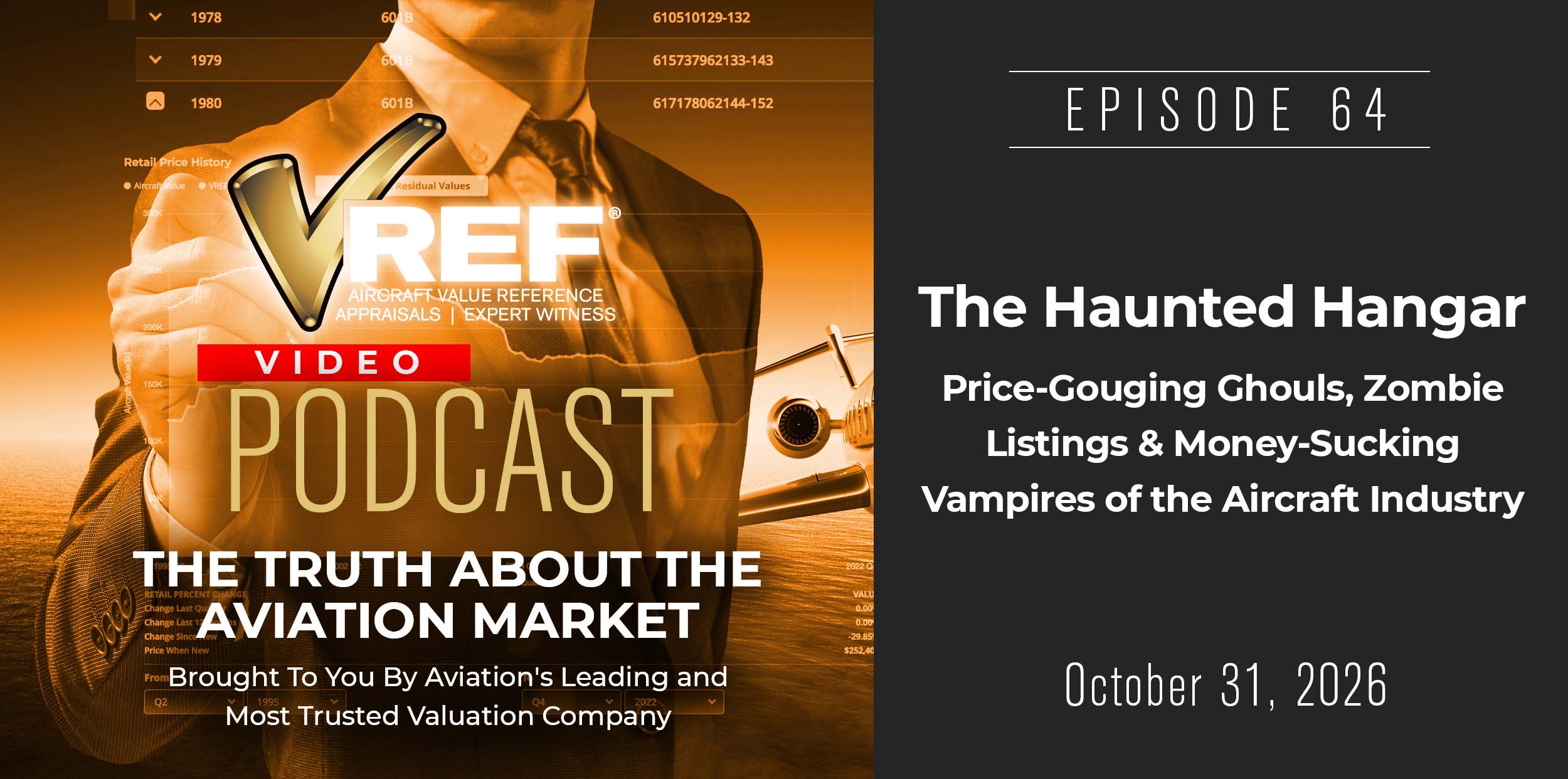


Podcast: The Truth About the Market
Host: Jason Zilberbrand, President of VREF
Should Business Aviation Finally Regulate the People in the Middle?
To broker the sale of a house in Illinois, a real estate license is required.
To broker a used yacht in Florida, the requirements include licensing, fingerprints, a background check, and a bond.
To sell a $35 million business jet in the United States?
You need a phone.
Over the past 12 months, VREF tracked approximately 4,000 retail business-jet and turboprop sales, involving more than 500 companies identified as brokers or dealers. Roughly half of those companies appeared on just one transaction during the entire year.
Yet aircraft sales brokers and dealers face no comparable nationwide licensing system, mandatory examination, or universal bonding requirement.
The aircraft itself is one of the most heavily regulated assets in the world.
The pilot is regulated.
The mechanic is regulated.
The operator is regulated.
But the people standing between buyers and sellers—setting prices, arranging transactions, accepting deposits, selling jet-card memberships, and structuring leases—often operate under dramatically lighter oversight.
That raises one of the most consequential and divisive questions facing business aviation:
Is it time to regulate the people in the middle?
Episode 62 of The Truth About the Aviation Market examines the strongest arguments for and against greater oversight of aircraft brokers, dealers, escrow agents, charter intermediaries, jet-card providers, and leasing structures.
The issue is not as simple as choosing between regulation and deregulation.
Additional rules could protect customer money, improve transparency, and establish meaningful accountability.
They could also create unnecessary bureaucracy, protect established firms from competition, and drive transactions into less transparent jurisdictions.
The question is not merely whether business aviation needs more rules.
It is what problem those rules would solve, who would enforce them, and whether they would actually work.
This episode makes both cases, examines lessons from other industries, and presents five possible paths forward.
The final decision belongs to the industry.
In this episode
- Why the people closest to an aircraft face extensive regulation while those closest to the money often face less oversight
- What is already regulated in business aviation—and what remains largely outside traditional licensing structures
- The differences between aircraft operators, charter brokers, sales brokers, dealers, escrow agents, and owner trustees
- Why prepaid jet-card and membership balances may receive fewer financial protections than public-charter passenger deposits
- Three ways a new regulatory system could work: federal oversight, state licensing, or industry self-regulation
- Why the FAA and Department of Transportation have different responsibilities
- How the tax code already influences business aviation
- What cabotage means, why the United States restricts who can operate domestic commercial flights, and what that suggests about aircraft transactions
- The five strongest arguments for greater regulation
- The six strongest arguments against it
- What aviation can learn from car dealers, yacht brokers, and real estate
- What Bernie Madoff, pre-2008 mortgage regulation, and the 1990 luxury tax reveal about regulatory failures
- Five possible reforms, from disclosure requirements to full broker and dealer licensing
- Six practical steps available today to protect buyers, owners, and their money without waiting for new legislation
The regulatory gap: who answers to whom today?
Before considering additional regulation, it is necessary to understand what already exists.
Aircraft and pilots
Aircraft are subject to certification, airworthiness, maintenance, inspection, and registration requirements.
Pilots operate under certificates, ratings, medical standards, recurrent training, and currency requirements.
These systems create extensive documentation and formal accountability.
Charter operators
Commercial charter operators face significant FAA oversight under Part 135, including requirements involving management personnel, training programs, maintenance, and operational qualifications.
FAA enforcement activity demonstrates that these requirements carry real consequences.
Charter brokers
Charter brokers operate under a substantially different framework.
Since 2019, federal rules have required important disclosures, including identifying the broker’s role and the entity responsible for operating a flight.
But the rules do not establish a comprehensive licensing, bonding, capital, or deposit-protection system comparable to those found in some other regulated industries.
Jet cards and memberships
Prepaid jet-card balances are often governed primarily by private contracts.
Depending on the arrangement, customer funds may become part of a company’s operating capital rather than remaining in an independently protected account.
This creates an important contrast with certain public-charter transactions, where federal rules require mechanisms to protect passenger payments.
A private-aviation customer may commit substantially more money while receiving fewer mandated financial safeguards.
Aircraft sales brokers and dealers
Aircraft sales intermediaries face no general federal licensing requirement comparable to real estate or securities brokerage.
There is no universal national examination, bonding system, or dedicated public disciplinary registry for aircraft sales brokers.
Voluntary professional accreditation exists, and many firms maintain meaningful internal standards. But participation is not mandatory.
VREF’s transaction analysis also highlights a significant transparency limitation: only approximately one-third of retail sales had a broker or dealer identified in the available transaction records.
That does not establish that the remaining transactions occurred without intermediaries.
It means the records do not consistently identify them.
Escrow and title agents
Aircraft escrow and title businesses can temporarily control millions of dollars during a single closing.
Yet there is no dedicated federal aircraft-escrow licensing regime comparable to the oversight applied to many other financial intermediaries.
The FAA Registry records aircraft documents. It is not a regulator of the financial transactions behind those filings.
Leasing and operational control
Certain aircraft leases are subject to truth-in-leasing requirements designed to identify who maintains operational control.
The challenge arises when a transaction presented as a lease functions more like an unauthorized charter arrangement.
Rules may exist on paper while improper activity remains difficult to identify until after a flight has occurred.
Taken together, the regulatory structure reveals a striking imbalance:
The closer an activity is to the airplane, the more heavily it tends to be regulated. The closer it is to the money, the less standardized the oversight may become.
Three ways business aviation could be regulated
Any serious proposal for additional oversight must answer a basic question:
Who would enforce it?
There are three principal approaches.
1. Federal regulation
A federal framework would likely involve the FAA, Department of Transportation, or both.
The FAA primarily addresses aviation safety.
The DOT has authority over important aviation economic and consumer matters.
Rules involving transaction disclosure, broker conduct, or customer deposits would therefore fit more naturally within the DOT’s economic and consumer-protection responsibilities.
The advantage is consistency.
Aircraft transactions routinely cross state lines. A national framework could establish common standards regardless of where an aircraft is registered, sold, financed, or delivered.
The disadvantages are equally significant.
Federal rulemaking can take years, require congressional action, and place additional responsibilities on agencies already facing substantial resource demands.
2. State licensing
State licensing would resemble the systems used in real estate and certain yacht markets.
Requirements could include examinations, background checks, surety bonds, education, complaint procedures, and revocable licenses.
The advantage is an established regulatory model with mechanisms for professional accountability.
The disadvantage is fragmentation.
An aircraft could be located in Texas, owned by a Delaware LLC, sold to an Illinois buyer, and closed through an Oklahoma escrow company.
Which state’s rules would govern the broker?
A patchwork of separate licensing systems could create substantial complexity for a market that operates nationally and internationally.
3. Industry self-regulation
A third possibility resembles the securities industry’s self-regulatory structure.
An industry-funded organization could administer examinations, licensing, compliance, and discipline while operating under federal oversight.
This approach would draw on industry expertise and potentially reduce the burden on taxpayers.
But it creates another risk:
The largest firms could have the greatest influence over the rules governing their competitors.
A regulatory system designed to protect customers could also become a barrier to entry.
The fourth lever: taxation
Federal tax policy already influences business aviation through deductions, reporting requirements, and enforcement.
The IRS has scrutinized the allocation of business and personal use of corporate aircraft.
Taxation can change behavior without establishing a licensing board.
But policies intended to raise revenue or influence aircraft ownership are not necessarily effective consumer-protection measures.
That distinction becomes important when examining the history of aviation regulation.
Cabotage: if it matters who flies, should it matter who sells?
One of aviation’s oldest regulatory principles creates an unusual contrast with the resale market.
Cabotage refers to the transportation of paying passengers or cargo between domestic points.
U.S. law generally restricts foreign air carriers from conducting domestic commercial transportation between U.S. destinations, subject to applicable exceptions and authorizations.
Foreign charter operators cannot simply enter the United States and compete freely for domestic point-to-point passenger business.
These restrictions reflect several longstanding objectives:
Protecting domestic aviation businesses and jobs.
Maintaining regulatory oversight of domestic transportation.
Preserving national control over important aviation infrastructure.
Addressing security and ownership concerns.
U.S. air-carrier citizenship and control requirements serve related purposes.
The principle is clear:
Who operates an aircraft matters.
But consider the financial and commercial transactions surrounding that same aircraft.
VREF’s analysis found that nearly six in ten aircraft buyers in the reviewed transactions were identified through LLCs, trusts, or owner-trustee structures rather than individuals or conventional operating companies.
Approximately 8% of sales involved exports or buyers outside the United States.
Business aviation is international, complex, and deeply dependent on intermediaries.
Yet the people arranging many of these transactions face fewer standardized professional licensing requirements than the people operating the aircraft.
This creates two competing arguments.
The case for additional oversight is that financial transactions, ownership structures, and intermediary relationships can carry important security and fraud risks.
The case against is that operating an aircraft and selling an aircraft are fundamentally different activities. Extending nationality or licensing restrictions into global aircraft commerce could damage legitimate international trade without meaningfully improving aviation safety.
The central question remains:
If it matters who flies the airplane, should it also matter who sells it?
The case FOR greater regulation
There are five major arguments supporting additional oversight.
1. Customer money is not consistently protected
Several recent aviation controversies have exposed vulnerabilities involving money held by intermediaries.
Aircraft escrow fraud.
Jet-card companies suspending operations while holding substantial prepaid customer balances.
Flight-school customers losing access to prepaid training funds.
Although these cases involved different business models and circumstances, they raise a common question:
Who independently verifies what happens to customer money?
Escrow, bonding, financial disclosures, and meaningful oversight could reduce some of these risks.
2. Other high-value markets regulate their middlemen
Real estate brokers are licensed.
Securities intermediaries operate within formal registration and compliance structures.
Certain yacht brokers must maintain licenses and bonds.
Motor-vehicle dealers face extensive state requirements.
Some public-charter passenger payments must be protected through escrow or other approved financial arrangements.
The absence of comparable nationwide standards for aircraft sales intermediaries creates an obvious policy question.
Why should a transaction involving a $35 million aircraft have fewer standardized intermediary protections than transactions involving substantially less expensive assets?
3. Buyers cannot always evaluate intermediary risk
Without a dedicated licensing system, there may be no public professional license to verify, no centralized disciplinary history, and no mandated solvency disclosures for particular aviation intermediaries.
Transaction records can also be incomplete.
Back-to-back aircraft sales, intermediary ownership, and rapid title transfers may require careful examination of FAA documents to establish what actually occurred.
Greater transparency could make due diligence easier and reduce uncertainty.
4. Financial conduct can create aviation safety problems
Illegal charter often begins as a commercial transaction.
A flight is marketed.
A customer pays.
A broker or intermediary arranges transportation.
If the actual operator lacks the required authority, the problem began before the aircraft left the ground.
Financial conduct and operational safety are not always separate concerns.
5. Voluntary oversight has limitations
Recent controversy surrounding legacy Citation single-pilot training exemptions demonstrates the risks associated with inadequate supervision of delegated or industry-administered processes.
Voluntary standards and professional associations can play important roles.
But their existence does not establish that every participant follows the same standards or faces meaningful consequences for violations.
The independent-value question
Across aviation transactions, a recurring source of risk is a number that has not been independently verified.
An asking price.
A deposit.
A lease rate.
A membership balance.
A claim about market value.
Not every failure can be prevented through valuation, but an independently supported number can expose inconsistencies before a transaction proceeds.
That is the role of VREF.
VREF does not broker, sell, charter, lease, or escrow aircraft. Its valuation work is independent of transaction commissions and focuses on market evidence, including closed transactions, aircraft-specific characteristics, and historical values.
Before committing to a major aircraft transaction, independent valuation provides an essential reference point.
Know what the aircraft is worth before accepting what someone says it is worth.
The tools for doing that already exist.
No new legislation is required.
The case AGAINST greater regulation
The arguments against additional licensing and oversight are substantial.
1. Many of the underlying abuses were already illegal
Wire fraud, money laundering, and unauthorized commercial aviation activity are already prohibited.
A new licensing requirement would not necessarily prevent a determined criminal from violating existing laws.
The central weakness may be enforcement rather than legislation.
More rules are not automatically better protection if nobody enforces them.
2. Aircraft buyers are often sophisticated
Major aircraft acquisitions typically involve attorneys, tax advisors, lenders, management companies, appraisers, inspectors, and escrow professionals.
Business aviation is not identical to a mass-market consumer industry.
Sophisticated participants frequently have access to tools and contractual protections that can substantially reduce transaction risk.
Additional mandatory requirements may duplicate safeguards already available to informed buyers.
3. Regulators face capacity constraints
Federal aviation authorities already manage extensive safety, certification, infrastructure, and enforcement responsibilities.
Creating additional licensing obligations without adequate staffing and resources could produce delays rather than meaningful protection.
A licensing system is only as useful as its ability to investigate complaints and enforce standards.
4. Licensing can protect incumbents
Large firms generally have more resources to satisfy bonding, examination, insurance, reporting, and compliance requirements.
Smaller independent brokers may face proportionally greater costs.
As a result, regulation designed to improve customer protection could unintentionally limit competition and strengthen established firms.
5. The industry already has safeguards
Independent title and escrow services.
Aircraft appraisals.
Pre-purchase inspections.
Legal representation.
Contractual protections.
Voluntary professional accreditation.
These tools already address many transaction risks.
The alternative to new regulation may be greater diligence in applying existing protections.
6. Aircraft transactions are global
Business aviation operates across national borders.
Aircraft are frequently purchased, financed, operated, and registered through international structures.
Excessive transaction costs or regulatory complexity could encourage activity to move into less transparent jurisdictions.
That outcome could reduce oversight rather than strengthen it.
Lessons from industries where regulation worked
Three established markets offer particularly relevant examples.
Used-car dealers
Dealer licensing, surety bonds, standardized disclosures, and title documentation provide buyers with defined protections.
The most useful lesson is not licensing alone.
It is the combination of accountability, financial remedies, written disclosures, and a documented transaction.
Yacht brokers
Yacht transactions resemble aircraft transactions in important ways.
The assets are expensive, mobile, frequently financed, and often owned through corporate structures.
Florida and California provide examples of broker licensing and bonding systems.
Importantly, these systems distinguish between professional intermediaries and many owners selling their own property.
The middleman can be regulated without regulating every owner.
Real estate
Real estate provides perhaps the clearest lesson concerning customer deposits.
Client funds are generally subject to trust-account or escrow requirements and may be subject to regulatory audit.
The objective is straightforward:
A customer’s deposit should not automatically become the broker’s operating capital.
Lessons from regulation that failed
Regulation can also produce expensive mistakes.
Bernie Madoff and the SEC
Madoff operated within a highly regulated financial system.
Registration existed.
Complaints existed.
Oversight authority existed.
Yet the fraud persisted.
The lesson:
Registration is not the same as meaningful supervision.
A license can create confidence without delivering protection if the activity behind it is not actually examined.
Mortgage regulation before 2008
Fragmented state licensing and weak information sharing created opportunities for problematic mortgage originators to move between jurisdictions.
The subsequent development of a national registration system demonstrated the importance of consistent standards and centralized records.
For aviation, the implication is clear:
A licensing system would need to follow participants across state lines.
The 1990 luxury tax
Federal luxury taxes imposed on products including aircraft and boats were associated with significant industry disruption.
The aircraft and boat provisions were later repealed.
The recession complicates any attempt to attribute all associated economic losses to the tax itself.
Nevertheless, the episode draws an important distinction:
A rule designed to punish a market is not the same as one designed to protect a customer from a defined risk.
What effective oversight might actually require
The strongest regulatory examples share several characteristics.
Customer money receives defined protection.
Material conflicts and transaction terms are disclosed in writing.
Violations can trigger enforceable consequences.
The weaker examples demonstrate the opposite problems:
Requirements that are not meaningfully enforced.
Disconnected jurisdictions.
Compliance systems that benefit incumbents more than customers.
And rules that address broad political objectives rather than specific, demonstrable harms.
These comparisons do not settle the aviation debate.
They provide a framework for designing better solutions.
Five possible paths forward
Rather than treating regulation as an all-or-nothing proposition, Episode 62 presents five distinct options.
Option 1: Require broker disclosure
Aircraft sales brokers would disclose who they represent, whether they represent both sides, how they are compensated, and whether they have an ownership or financial interest in the aircraft.
The information would be provided in writing before the letter of intent.
This approach emphasizes transparency without requiring a new professional license.
Option 2: Require independent escrow for deposits
Customer deposits would be held by independent, qualified aircraft escrow and title companies rather than deposited into broker or seller operating accounts.
The objective is financial separation and transaction protection.
Option 3: Protect jet-card and membership balances
Prepaid customer balances could be protected through segregated escrow, bonding, or comparable mechanisms.
Providers would disclose what portion of customer funds is protected and how those protections operate.
Option 4: License and bond escrow and trust agents
Businesses responsible for handling major aircraft transaction funds could face formal licensing, background checks, bonding requirements, and disciplinary oversight.
This focuses regulation on the entities controlling customer money.
Option 5: License aircraft brokers and dealers
The broadest proposal would establish formal professional licensing.
Potential requirements could include examinations, background checks, surety bonds, continuing education, disclosures, and a public complaint process.
This would resemble established intermediary-licensing systems in other high-value markets.
But it would also introduce greater compliance costs and the possibility of reduced competition.
The fundamental choice
Options 1 through 4 primarily address transparency, deposits, and financial protection without necessarily requiring aircraft sales brokers to obtain professional licenses.
Option 5 goes further.
It regulates who may participate as a professional intermediary.
The difference is significant.
Is the central problem who sells the airplane?
Or is it who controls the money and what protections exist around the transaction?
Six things available today—without a new law
Whatever direction future regulation takes, buyers and owners can take meaningful steps immediately.
1. Protect aircraft deposits
Use independent, qualified aircraft title and escrow services.
Verify wire instructions by calling a phone number obtained independently—not solely from an email.
2. Require broker disclosures
Obtain written confirmation of who the broker represents, whether both sides are represented, how compensation works, and whether the broker has any ownership interest.
3. Investigate prepaid membership funds
Before purchasing a jet card or membership, determine whether customer balances are segregated, escrowed, bonded, or available for operating expenses.
Obtain the explanation in writing.
4. Verify charter operators
Identify the actual aircraft operator and verify its applicable authority.
A charter broker’s involvement does not substitute for checking the company conducting the flight.
5. Understand operational control
For applicable aircraft leases, confirm that required documentation and truth-in-leasing provisions are in place.
Determine which party actually maintains operational control.
6. Obtain independent valuation
Before committing to a transaction, establish an aircraft’s value using evidence independent of the parties compensated by the deal.
Market value should be established through defensible data—not simply an asking price or sales presentation.
The aviation industry gets the last word
Business aviation has spent decades establishing who can build, maintain, inspect, operate, and fly aircraft.
The regulatory framework surrounding those activities is extensive.
But the commercial and financial systems around an aircraft transaction operate under different standards.
That difference is real.
Whether it represents a necessary feature of sophisticated international commerce or a serious gap in customer protection remains open to debate.
The strongest argument for greater regulation is straightforward:
Protect the money. Create accountability. Make conflicts and financial risks visible.
The strongest argument against it is equally serious:
Enforce existing laws. Use the protections already available. Do not create expensive rules that principally benefit the largest firms.
The question is not whether business aviation should become more bureaucratic.
It is whether targeted oversight could make transactions safer, more transparent, and more trustworthy without damaging the market it is intended to protect.
And there are two questions for the industry:
1. If it matters who flies an airplane, should it matter who sells it?
2. Where should the line be drawn—Option 1, 2, 3, 4, 5, none of them, or another solution?
Owners, buyers, brokers, dealers, operators, lenders, appraisers, and attorneys are invited to participate.
Share a position in the episode comments or email info@vref.com. Include the perspective or role behind the opinion.
VREF plans to count the responses and share compelling arguments from both sides in a future episode.
This is one debate that requires every part of the industry at the table.
Frequently Asked Questions
Are aircraft brokers required to have a license in the United States?
There is no comprehensive federal licensing system specifically governing aircraft sales brokers and dealers comparable to the systems used for real estate agents or securities brokers.
Aircraft brokers do not generally have to pass a national licensing examination, obtain a standardized professional bond, or participate in a dedicated federal disciplinary registry simply to broker an aircraft sale.
That does not mean aircraft transactions are exempt from other laws. Fraud, contractual obligations, financial regulations, registration requirements, and other applicable federal and state laws still apply.
The debate is whether existing protections are sufficient—or whether aviation needs additional rules specifically governing its intermediaries.
Are charter brokers regulated by the FAA or DOT?
Charter brokers are subject to federal rules administered by the Department of Transportation, including disclosure requirements that took effect in 2019.
Those rules require important information about the broker’s role and the entity actually operating the flight.
However, this framework does not establish a comprehensive broker licensing system or universally require private-charter deposits to be protected through escrow or bonding.
Charter operators face a different level of oversight. Companies conducting commercial flights under Part 135 must satisfy substantial FAA certification, operational, maintenance, and training requirements.
The broker arranging the flight and the operator conducting it are not necessarily the same company—and they do not face identical regulatory obligations.
Is money deposited into an aircraft escrow account federally protected?
Not automatically.
The FAA Registry records aircraft ownership and other documents, but it does not supervise aircraft escrow companies’ financial operations or guarantee the money held in their accounts.
Aircraft escrow arrangements can provide important transactional safeguards, but the level of protection depends on the escrow company’s structure, the bank accounts involved, the applicable agreements, and available insurance or bonding.
Before wiring funds, buyers should verify the escrow provider independently, understand how the funds are held, and confirm wire instructions through a trusted telephone number obtained separately from the transaction email.
The word “escrow” is not, by itself, a guarantee. The structure behind it matters.
Are private jet-card deposits protected if the company goes bankrupt?
Not necessarily.
Many private jet-card and membership programs are governed primarily by their contracts. Depending on the provider and agreement, prepaid customer funds may become general operating capital rather than remaining in a segregated account.
If the company experiences financial distress, customers may face substantial difficulty recovering unused balances.
Certain public-charter arrangements are subject to federal passenger-payment protection requirements, but comparable protections do not automatically apply to every private jet-card program.
Before purchasing, customers should determine whether their funds are segregated, escrowed, bonded, or otherwise protected—and obtain the answers in writing.
What is the difference between an aircraft broker and an aircraft dealer?
An aircraft broker generally helps arrange a transaction between a buyer and seller, typically without taking ownership of the aircraft.
An aircraft dealer may purchase the aircraft, take title, hold it as inventory, and subsequently resell it.
The distinction matters because ownership, financial exposure, compensation, and potential conflicts of interest can differ substantially between the two arrangements.
A buyer should understand whether the company involved is representing another party, acting as principal, or participating financially in more than one part of the transaction.
What is cabotage, and why does it matter to aircraft regulation?
Cabotage refers to the transportation of paying passengers or cargo between domestic points within a country.
U.S. law generally restricts foreign carriers from conducting commercial transportation between two U.S. destinations, subject to applicable exceptions and authorizations.
These restrictions help protect domestic aviation businesses and jobs, preserve regulatory oversight, and address national security and ownership concerns.
Cabotage raises a larger philosophical question:
If the United States places such importance on who operates commercial flights, should it also place greater scrutiny on the people who sell aircraft, arrange transactions, and control customer money?
That question is central to Episode 62.
Who would regulate aircraft brokers if new licensing requirements were introduced?
There are three principal possibilities.
Federal oversight: A nationwide framework administered through an appropriate federal agency. The DOT would be a natural candidate for rules concerning aviation commerce and consumer financial protection.
State licensing: A system resembling real estate or yacht-broker regulation, with examinations, background checks, bonding, and disciplinary procedures.
Industry self-regulation: An industry-funded organization administering professional standards under federal oversight, similar in structure to certain securities-industry arrangements.
Each option involves tradeoffs involving consistency, cost, enforcement capacity, industry expertise, and competition.
Would requiring aircraft brokers to be licensed prevent fraud?
Licensing could improve transparency and accountability, but it would not eliminate fraud.
Many of the most serious aviation-related financial abuses discussed in the episode involved conduct that was already illegal.
Bernie Madoff’s fraud provides an especially important cautionary example: registration, examinations, and government oversight existed, yet serious failures continued.
Licensing is only meaningful when accompanied by effective investigation, supervision, and enforcement.
A license can establish accountability. It cannot replace diligence.
Could additional regulation make aircraft transactions more expensive?
Yes.
Licensing, bonding, examinations, mandatory education, reporting, and compliance requirements impose costs.
Large companies may be better positioned to absorb those expenses than smaller independent brokers.
Poorly designed requirements could reduce competition, slow transactions, or encourage some activity to move into jurisdictions with fewer restrictions.
The strongest case for regulation therefore depends on identifying specific risks and applying protections proportionate to those risks.
How do other industries protect customers dealing with expensive assets?
Several industries provide useful examples.
Real estate: Licensing requirements and regulated trust or escrow arrangements can help protect earnest money.
Yacht brokerage: States including Florida and California have licensing and bonding requirements for certain professional yacht brokers.
Automobile dealerships: Dealer licensing, surety bonds, title procedures, and standardized disclosures provide defined forms of accountability and customer protection.
These systems do not eliminate misconduct.
They demonstrate ways to create financial remedies, enforceable standards, and clearer transaction records without prohibiting ordinary buying and selling.
What is the difference between regulating aircraft brokers and protecting aircraft deposits?
This is one of the most important distinctions in the episode.
Protecting deposits addresses what happens to customer money.
Licensing brokers addresses who is permitted to act as a professional intermediary.
A requirement to use independent escrow could potentially improve transaction protection without requiring every aircraft sales broker to obtain a government license.
Likewise, mandatory disclosure of compensation and conflicts of interest could improve transparency without creating an extensive new licensing system.
The key question is whether the industry’s principal problem is insufficient professional oversight, inadequate financial protection, or both.
What are the five regulatory options presented in Episode 62?
The episode presents five possible approaches, arranged from lighter to more extensive intervention.
Option 1 — Broker disclosure: Require written disclosure of representation, compensation, and financial interests.
Option 2 — Independent escrow: Require customer transaction deposits to be held by qualified independent escrow providers rather than in brokers’ or sellers’ operating accounts.
Option 3 — Jet-card deposit protection: Establish safeguards for prepaid membership balances through escrow, bonding, or similar mechanisms.
Option 4 — Escrow-agent licensing and bonding: Require formal oversight of businesses handling aircraft transaction funds.
Option 5 — Full broker and dealer licensing: Establish professional examinations, background checks, bonding, continuing education, and disciplinary procedures.
These are proposals for discussion, not five regulations currently in effect.
They illustrate different levels of intervention and the distinction between regulating financial conduct and regulating professional participation.
What is a truth-in-leasing clause?
Certain aircraft leasing arrangements are subject to FAA truth-in-leasing requirements.
These provisions are intended to identify the party responsible for operational control of the aircraft and establish related documentation and notification obligations.
Operational control matters because the party legally and practically responsible for conducting the flight must be identifiable.
A lease should not be used to disguise an arrangement that is actually unauthorized commercial charter activity.
Anyone entering a covered aircraft lease should verify the applicable requirements and understand who maintains operational control.
Is aircraft appraisal a licensed profession?
There is no universal federal license required simply to perform aircraft appraisals.
Professional accreditation is voluntary, although recognized appraisal credentials and standards can provide important indications of training, methodology, and accountability.
This is relevant to the broader regulatory debate because aircraft appraisers, like brokers and other transaction participants, do not operate under a single mandatory national professional licensing system.
Independent qualifications, professional standards, and defensible methodology therefore matter.
Why should an aircraft buyer obtain an independent valuation before making an offer?
Because the asking price is not necessarily the market value.
An aircraft’s value depends on actual market activity, condition, maintenance status, equipment, history, and other aircraft-specific factors.
An independent valuation can help establish whether the proposed price is supported by the available evidence.
It can also help buyers, sellers, lenders, insurers, and appraisers evaluate risk using a consistent reference point.
VREF Online provides current and historical aircraft values informed by transaction evidence rather than relying solely on advertised asking prices.
An independent valuation does not replace legal, title, escrow, or financial due diligence. It addresses a separate but essential question:
What is the aircraft actually worth?
What can aircraft buyers do to protect themselves without new regulations?
Meaningful protections already exist.
Use qualified independent escrow services and verify wire instructions directly. Obtain written disclosures from brokers regarding representation and compensation. Investigate how prepaid program balances are protected. Verify the identity and authority of charter operators. Understand operational control before entering aircraft leases. Obtain an independent aircraft valuation before committing to a major transaction.
These precautions cannot eliminate every risk, but they can reduce exposure to avoidable problems.
The most important protection is knowing what is being purchased, who is responsible, where the money goes, and what independent evidence supports the transaction.
Does VREF support regulating aircraft brokers and dealers?
Episode 62 presents the strongest arguments on both sides rather than endorsing a single comprehensive regulatory model.
Additional oversight could improve financial protection and accountability.
It could also introduce unnecessary costs, restrict competition, and create bureaucracy without meaningfully reducing misconduct.
The distinction between protecting customer funds and licensing professional intermediaries is especially important.
The episode leaves the industry with two questions:
If it matters who flies an airplane, should it matter who sells it?
And where should the line be drawn?
Owners, buyers, brokers, dealers, operators, lenders, attorneys, and other aviation professionals are invited to share their perspectives in the episode comments or by emailing info@vref.com.
VREF plans to tally the responses and share arguments from both sides in a future episode.
The bottom line
The aircraft is regulated.
The pilot is regulated.
The mechanic is regulated.
The operator is regulated.
But the financial and transactional infrastructure surrounding those aircraft often operates under far less standardized oversight.
Perhaps the solution is comprehensive licensing.
Perhaps it is more targeted financial protection.
Perhaps it is better enforcement of the laws already in place.
Or perhaps the answer lies in a combination of all three.
What matters is identifying the actual risk—and choosing a response supported by evidence rather than assumptions.
Who answers to whom?
The question is on the table.
Now the industry decides.
CLICK HERE TO SUBSCRIBE TO VREF ONLINE
VREF it before you make the call.
Fly safe. Stay smart.