
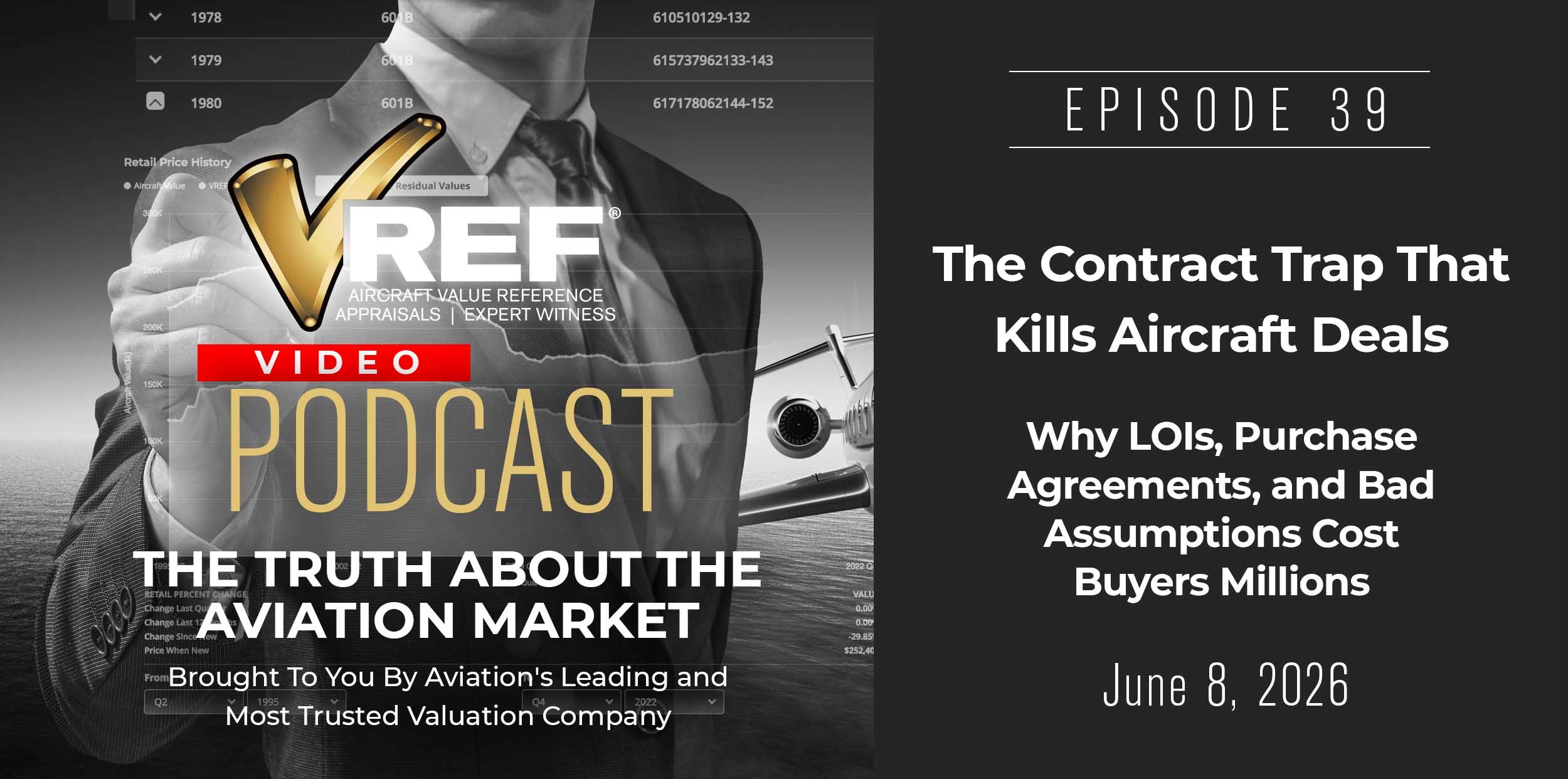
Podcast: The Truth About the Market
Host: Jason Zilberbrand, President of VREF
Most aircraft deals do not fail because the airplane is bad.
They fail because the assumptions were bad.
A buyer thinks they negotiated certainty.
A seller thinks they preserved flexibility.
The broker tries to keep momentum alive.
The attorneys tighten the language.
The pre-buy begins.
And suddenly, everyone realizes they were not operating from the same deal.
In this episode of *The Truth About the Market*, Jason breaks down one of the most misunderstood and financially dangerous parts of aircraft acquisition: the paperwork.
Not engines.
Not avionics.
Not maintenance programs.
Contracts.
The letter of intent.
The aircraft purchase agreement.
The inspection language.
The deposit structure.
The delivery conditions.
The discrepancy standards.
The definition of airworthiness.
Because in aviation, the paperwork does not just document the deal.
It controls the leverage.
And if the LOI and APA are weak, vague, recycled, or poorly understood, the transaction can fall apart long before closing.
In this episode, we cover:
- Why most failed aircraft deals are caused by mismatched assumptions, not bad aircraft
- How a single sentence in an LOI or APA can shift leverage, responsibility, and liability
- Why buyers should never fall in love with an aircraft before the pre-buy is complete
- Why sellers often assume a good airplane means a clean transaction, and why that assumption is dangerous
- How the letter of intent acts as the roadmap for the entire transaction
- Why “non-binding” does not mean irrelevant, meaningless, or harmless
- How confidentiality, exclusivity, deposits, broker protections, and jurisdiction can survive inside the LOI
- Why sophisticated buyers use the LOI to identify risk early
- Why inexperienced buyers focus almost entirely on price
- How a buyer can overpay for a good aircraft and survive, but buy a “cheap” aircraft and walk into disaster
- What every LOI should define before pressure enters the transaction
- Why deposit language matters, especially when money goes hard and becomes non-refundable
- How vague inspection rights create conflict once mechanics start opening panels
- Why timeline discipline matters when financing, insurance, maintenance delays, and parts availability are all under pressure
- Why buyers should walk away when sellers restrict reasonable due diligence
- How poorly defined inspection scope turns into guaranteed conflict
- Why “airworthiness” is one of the most misunderstood words in aircraft transactions
- How cosmetic issues, deferred maintenance, future financial exposure, and true airworthiness items get confused
- Why fresh paint and new interiors can hide deeper maintenance realities
- How the APA turns the transaction from conceptual to enforceable
- Why the purchase agreement governs execution, remedies, obligations, defaults, delivery, title, liens, liability, and funding mechanics
- Why attorneys can help, but legal teams do not automatically protect the aircraft deal
- How lawyers may understand contracts without fully understanding aircraft
- Why recycled purchase agreements can become extremely dangerous
- Why a generic aircraft purchase agreement may be useless in a complex turbine or business jet transaction
- How ambiguity inside an APA creates litigation risk
- Why vague record standards can trigger disputes over missing logs, unsigned entries, traceability, and maintenance continuity
- How “as is, where is” language is often misunderstood by both buyers and sellers
- Why “as is” does not automatically eliminate every seller obligation
- How delivery condition, title condition, inspection rights, records, maintenance programs, and undisclosed issues still matter
- Why handshake culture still gets buyers into trouble
- How liens, title issues, unresolved maintenance invoices, tax claims, and security interests can follow an aircraft after closing
- Why damage history language like “minor repair,” “hangar rash,” or “professionally repaired” can hide major valuation risk
- Why missing logs can devastate aircraft value, financing, insurance, and resale
- How narco exposure, seizure history, law enforcement history, or unclear international ownership chains can create lasting stigma
- Why the pre-buy is not there to validate excitement, but to uncover risk
- Why the buyers who survive long term are the ones willing to walk away when the facts stop matching the story
- Why trying to save money on attorneys, title specialists, maintenance review, appraisers, or experienced brokers often becomes expensive later
- How good brokers manage psychology, communication, timelines, expectations, and deal survival
- Why aircraft transactions are usually lost in the details, not the headline price
- Why the cheapest part of aircraft ownership is often the due diligence
- Why closing transfers not just ownership, but risk, liability, responsibility, and future exposure
Jason also explains why today’s market makes disciplined transaction structure more important than ever.
Financing is tighter.
Insurance scrutiny is higher.
Maintenance costs are rising.
Parts availability is unpredictable.
Aging fleets are exposing deferred realities.
Buyers are becoming more selective.
Lenders are demanding more documentation.
In that environment, vague paperwork is not just sloppy.
It is dangerous.
The bottom line:
An aircraft transaction is not just a transfer of ownership.
It is a negotiated transfer of risk.
The LOI establishes alignment.
The APA defines obligations.
The inspection challenges assumptions.
And closing reveals whether the process was disciplined from the beginning.
If you do not understand the paperwork, you do not fully understand the transaction.
And if you do not fully understand the transaction, you do not fully understand your risk.
For accurate, defensible aircraft valuations trusted by lenders, insurers, attorneys, operators, and aviation professionals worldwide, get started with your VREF Online Membership today.
Fly safe. Stay smart.