

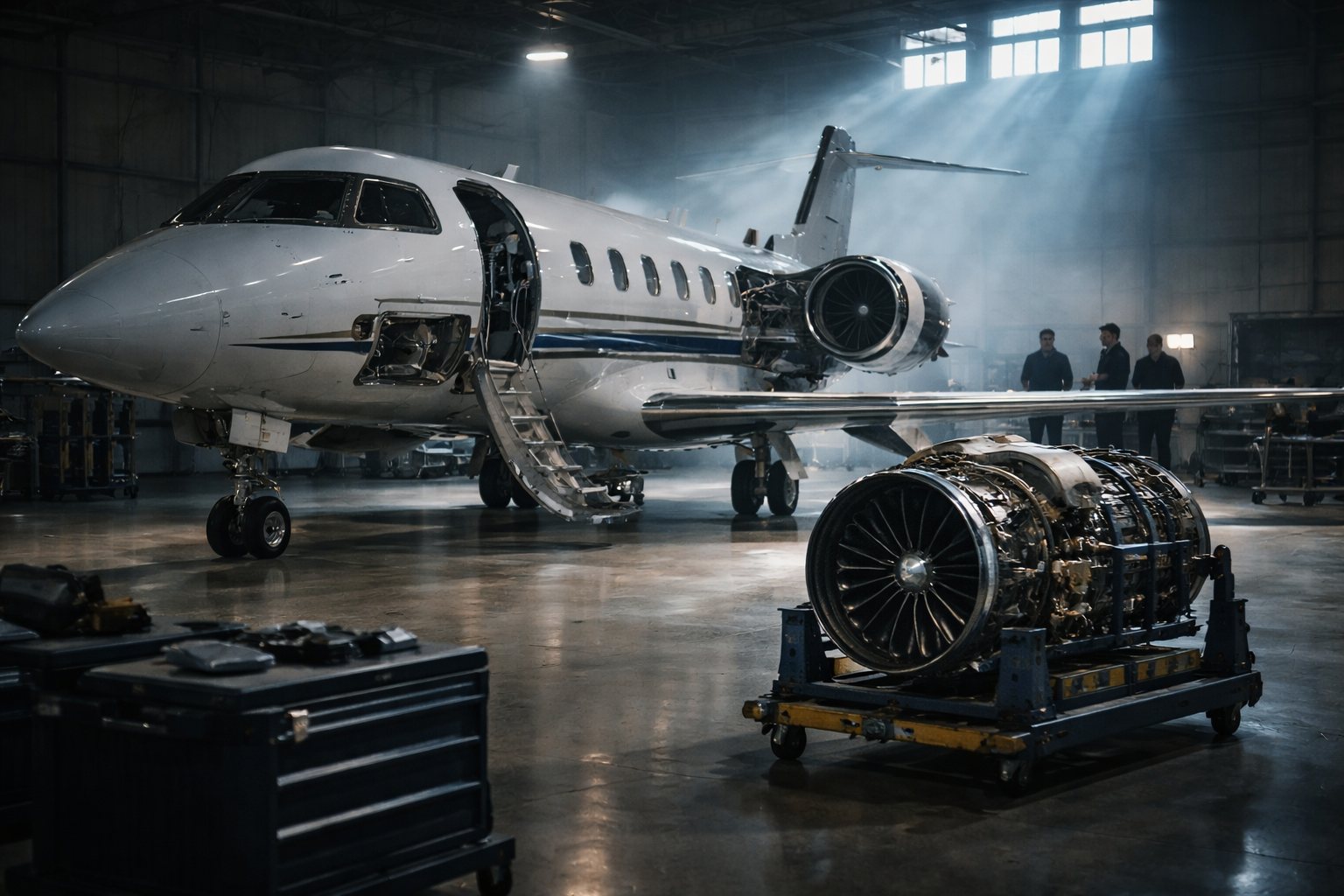
Aircraft ownership is a game of managing lifecycles. For years, an aircraft serves as a powerful transportation platform and a valuable productivity tool. But no asset flies forever. Over time, operating economics erode, maintenance costs escalate, and market liquidity tightens. Eventually, every aircraft crosses an invisible but critical line where it stops being worth more as a flying machine and starts being worth more in pieces.
The decision to part out an aircraft is never arbitrary, and it is rarely easy. It is a strategic financial move driven by converging economic signals that make continued operation irrational. Recognizing these signals is one of the most important skills an owner or fleet manager can possess. Just because an aircraft has part-out value does not mean that value is easily realized, but ignoring the signs is a sure way to destroy capital.
So, how do you know when your aircraft is ready for its final transformation from a single operating asset into a distributed global inventory? Here are the key triggers and evaluation criteria.
Signal 1: The Maintenance Cliff Approaches
The most common and powerful trigger for a part-out decision is a major, unfunded maintenance event. As an aircraft ages, it faces a series of expensive, calendar-driven inspections and overhauls that can easily exceed the asset’s residual value.
Key maintenance events to watch for include:
- Heavy Airframe Checks: These are extensive structural inspections that require significant disassembly and downtime. For large-cabin jets, a 96-month or 12-year inspection can run into the hundreds of thousands, or even millions, of dollars.
- Landing Gear Overhauls: Typically required every 10 years, overhauling the landing gear is a capital-intensive event that can ground an aircraft for weeks.
- Major Structural Inspections: As an airframe accumulates hours and cycles, it may require specific inspections for known fatigue or corrosion issues, which can uncover costly repairs.
When an aircraft is facing one of these “maintenance cliffs,” an owner must perform a cold, hard calculation. If the cost of the upcoming event is 25%, 50%, or even 100% of the aircraft’s current market value, it often makes no financial sense to proceed. The capital is better deployed elsewhere, and the aircraft becomes a prime candidate for a part-out.
Signal 2: Engine Program Expiration or “Run-Out” Status
Engines are the heart of an aircraft’s value, both as a flying machine and as a collection of parts. Their maintenance status is therefore a primary driver of the part-out decision.
The trigger often comes in one of two forms:
- Engine Program Expiration: For aircraft enrolled on hourly maintenance programs like JSSI, Rolls-Royce CorporateCare, or Pratt & Whitney’s ESP, the coverage eventually expires. Once the program ends, the owner is suddenly exposed to the full, uncapped cost of future engine maintenance. That predictability disappears, and the financial risk skyrockets.
- “Run-Out” Engines: For engines not on a program, the critical metric is “time remaining” until the next major overhaul. When the engines have little to no time left, they are considered “run-out.” The cost to overhaul a pair of engines on a mid-size or large-cabin jet can easily be seven figures.
An owner of an aircraft with run-out engines faces a stark choice: invest millions in the powerplants or sell the aircraft for its residual value. In this scenario, the market for the whole aircraft is extremely limited. However, the market for its other components—the APU, landing gear, and avionics—may still be strong. A part-out allows the owner to monetize these assets without first funding the massive engine liability.
Signal 3: Avionics Obsolescence and Mandate-Driven Upgrades
Technology is another powerful force that pushes aircraft toward retirement. Cockpit avionics are constantly evolving, and regulatory bodies frequently issue mandates that require expensive upgrades to continue operating in controlled airspace.
The ADS-B Out mandate was a perfect example. Owners of older aircraft were faced with a six-figure bill to upgrade their flight decks. For an owner of a 25-year-old jet worth only a few million dollars, spending $200,000 on avionics is a difficult investment to justify, as it rarely adds equivalent value on resale.
When faced with a mandatory, expensive upgrade, an owner must ask:
- Does this investment make sense given the aircraft’s age and overall value?
- Will I ever see a return on this capital?
- Are there other, more cost-effective options?
Often, the most rational answer is to forgo the upgrade and retire the aircraft. While its outdated avionics have little to no value, the airframe can be parted out to recover the value of its engines and other mechanical systems.
Signal 4: The Divergence of Whole vs. Component Value
This is the ultimate economic signal that underpins all part-out decisions. You must constantly evaluate the relationship between your aircraft’s value as a flying asset versus the aggregate value of its components.
As an aircraft ages, these two values move apart.
- Whole Aircraft Value depreciates quickly as buyers price in the future costs of maintenance, upgrades, and operational inefficiencies.
- Component Value often remains stable or declines much more slowly. The demand for serviceable parts to support the rest of the active fleet creates a resilient market.
When the sum of the parts officially exceeds the value of the whole, you have reached the tear-down arbitrage point. To identify this, you need accurate, data-driven valuations for both the intact aircraft and its key components. This is not a “back of the napkin” calculation. It requires professional analysis from valuation experts who understand both the whole aircraft resale market and the secondary parts market.
A Cautionary Reality: Patience and Partnerships Are Key
Identifying that your aircraft is a candidate for part-out is the first step. Successfully monetizing it is another matter entirely. Just because an aircraft has theoretical part-out value does not mean that value is easily realized.
- Time: Component sales take time. Engines and APUs might move quickly, but other parts may sit in inventory for years before a buyer emerges. This is not a fast liquidation.
- Infrastructure: Executing a tear-down requires a certified disassembly facility, a global parts distribution network, and an immense amount of regulatory compliance. It is not a DIY project.
- Expertise: Realizing maximum value requires partnerships with institutional players—tear-down specialists, parts distributors, and asset managers—who have the infrastructure and expertise to manage the process.
The decision to part out an aircraft should be a deliberate, data-driven strategy, not a last-ditch reaction to a financial crisis. By monitoring these key signals, owners can anticipate the end of their aircraft’s operational life and proactively plan a final, profitable exit. In aviation, value does not have to end when the flying stops; it simply changes form.
Ready to make informed, data-backed decisions for your aircraft’s future?
Subscribe to VREF Online today for real-time valuations, trusted market intelligence, and the expertise you need to maximize your asset’s value—whether you fly, sell, or part out.
Don’t leave your aircraft’s next chapter up to chance—get the industry’s best data in your corner with VREF Online.