
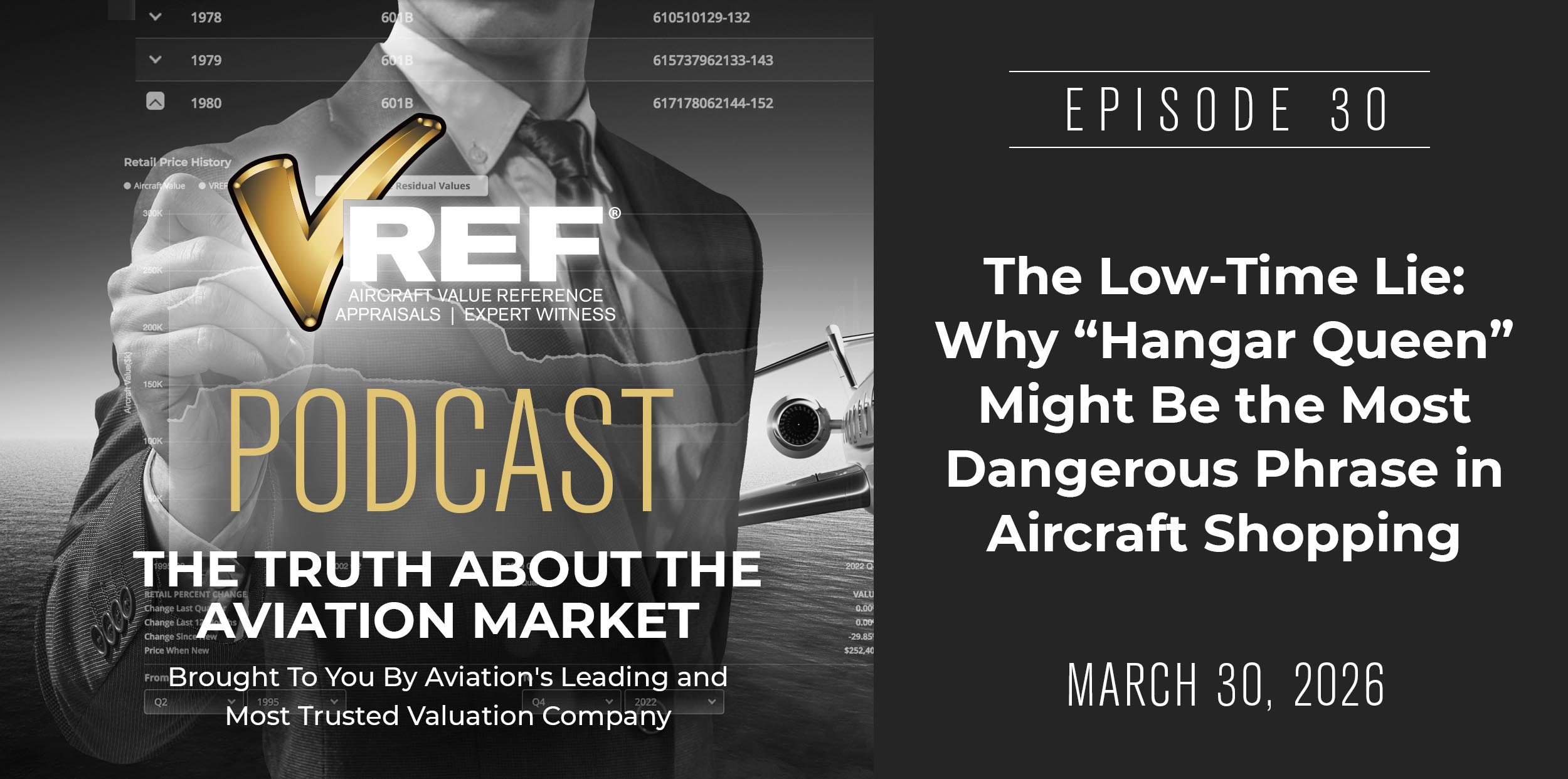
Podcast: The Truth About the Market
Host: Jason Zilberbrand, President of VREF
“Low total time” sounds like a selling point.
In aviation, it often is.
It shows up in listings, broker calls, and buyer wish lists as if those three words settle the question of quality before the airplane is even inspected.
But strip away the assumption, and what’s left is a far less comforting truth: airplanes are not preserved by sitting still. They are preserved by being flown, maintained, exercised, and monitored over time.
In this episode of The Truth About the Market, Jason breaks down one of the most persistent myths in aircraft buying: the belief that fewer hours automatically means less risk.
This is not an argument against low-time aircraft.
It is an argument against lazy thinking.
Because in aviation, inactivity has its own cost structure. And in some cases, the airplane with the most appealing spec sheet is the one carrying the quietest mechanical risk.
Here’s what you’ll discover in this episode:
- Why “low total time” can create a false sense of safety before due diligence even begins
- What actually happens inside an engine when an airplane sits too long
- Why corrosion, dried seals, stagnant fluids, and unexercised systems can become the real legacy of inactivity
- The mechanical reason engines often prefer regular use over long-term idleness
- Why calendar time still matters, even when flight hours remain low
- The hidden maintenance trap that catches buyers who focus only on hours since overhaul
- How lenders evaluate inactive aircraft differently once calendar-driven exposure comes into view
- Why a low-time airplane can still produce higher financing risk than a regularly flown one
- The valuation problem created when an aircraft’s history looks attractive on paper but ambiguous in practice
- What experienced buyers really look for beyond total time
- When low time is actually a legitimate positive — and what must exist to support it
- The difference between a carefully preserved aircraft and a true hangar queen
- Why consistent use often creates more transparency than long-term storage ever will
Jason also explains why the market does not reward inactivity nearly as much as buyers assume, and why an aircraft’s true condition depends far more on maintenance discipline, storage quality, and operational rhythm than on a simple number in a listing.
The bottom line:
Airplanes are not cars.
Low mileage logic does not transfer cleanly into aviation.
And if you confuse low use with low risk, you may be buying the most expensive kind of surprise: the one hidden behind a “perfect” spec sheet.
If you’re buying, selling, financing, insuring, or evaluating aircraft, this episode will change how you look at low-time airplanes.
For accurate, defensible aircraft valuations trusted by lenders, insurers, brokers, and owners worldwide, visit VREF.com.
Fly safe. Stay smart.